Highlights
- ICP identification is the first step in B2B SaaS lead generation, laying the foundation for higher conversion rates.
- Firmographics alone (industry, employee size) can’t predict buying readiness. Companies must identify technographic and behavioral signals to identify ICPs better.
- ICPs need regular evaluation. Business profiles change, and their needs evolve, so their evaluation is periodic and not a one-time identification process.
- Businesses must also look beyond their ICPs to find accounts that convert, retain, and expand, even if they don’t fit their perfect ICP criteria.
- ICP identification requires a layered framework comprising firmographic, technographic, behavioral, buying-readiness, and negative indicators.
Most B2B SaaS teams treat ICP identification as a checkbox exercise. It’s not about a shortage of data or tools, but a failure to keep revisiting who the ideal customer actually is as markets and buyer priorities shift. Getting the ICP right means layering technographic and behavioral signals onto firmographic data, then rebuilding the profile. It also requires evaluating the poor-fit account alongside the best-fit accounts to gain a 360-degree view of the ICPs.
Introduction
Ideal Customer Profile (ICP) identification is one of the critical steps to a successful B2B lead generation strategy. But often, ICPs are ignored, and businesses struggle in their demand generation and lead generation efforts. They leverage the latest technology and intent data for personalization, but doing so requires getting back to basics. It starts with finding your ideal customer profile (ICP) because everything in B2B marketing and sales centers on your target audience, your ICPs, and buyer personas. So, it is the most important step in your B2B SaaS lead-generation strategy. Let’s say, for instance, you are targeting a logistics company, a banking and financial organization, or a retail company. Within them, you are targeting chief financial officers, chief marketing officers, or digital transformation leaders for your SaaS products; it’s important to define the organizations first, then the people within those ICPs, to market your product effectively. But ICP identification is an iterative process that should ultimately support the development of a B2B SaaS lead generation strategy and the generation of highly qualified leads.
What Is Ideal Customer Profile Identification?
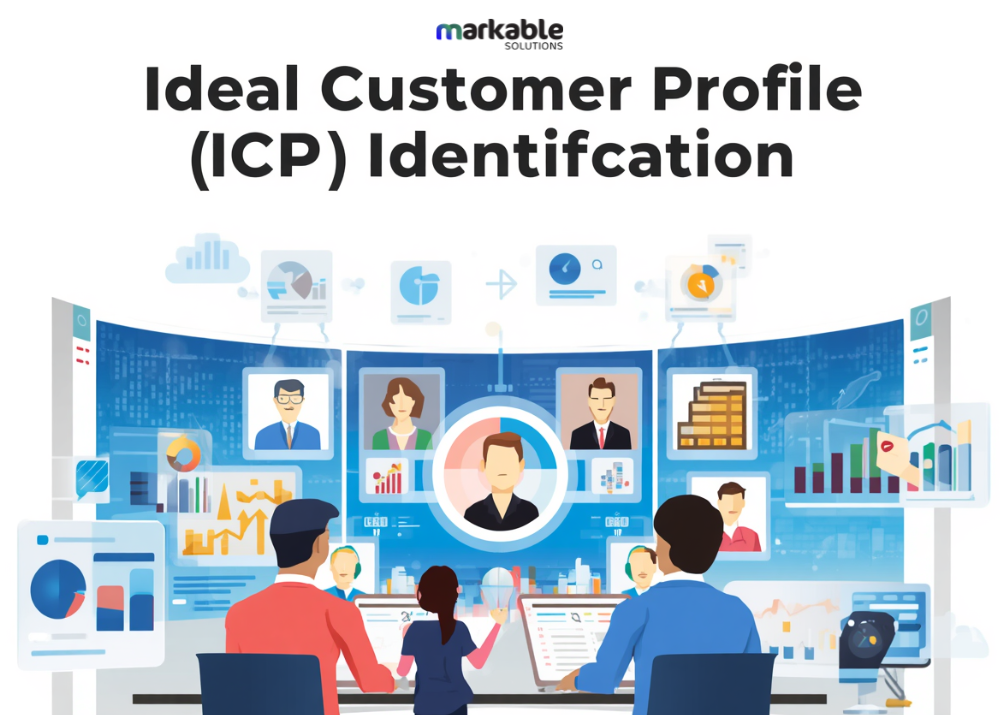
An ideal customer profile (ICP) is a comprehensive description of a company that is likely to buy from you, retain, and expand its relationship with your business. Here, one important point to note is that we are not talking about individual buyers but about your target organization as a whole. Buyer personas are individuals within these organizations who would engage with you. You would communicate with them to understand their budget approval process, their decision-making authority, their needs, and the timeline for the specific purchase.
Why Most Companies Struggle with ICP Identification and Predictive Revenue Pipeline
ICP identification may sound like an easy, simple process on paper, but when implemented, the results often do not meet expectations. The problem may vary. Let’s discuss different scenarios where companies go wrong with ICP identification and how they can fix them.
- Incomplete parameters: Are you evaluating your ICPs solely based on firmographics? Industry and employee size define the ICP, but they alone cannot indicate whether a company is ready to buy. The most important missing part of the puzzle is the technographic data and pain point. Intent data can reveal these critical aspects of an ICP. A B2B SaaS company should consider these important traits before finalizing ICPs for their demand generation and B2B lead generation programs. Intent signals help understand buyer behavior and help anticipate their needs. These intent signals guide the marketing and sales teams to personalize their engagement along with the ICP’s expectations.
- Lack of data enrichment: Well, you have built your ICPs and, for that matter, your buyer personas, and they are continuously referenced in your demand and lead generation programs every quarter. Well, it’s one of the most common mistakes B2B SaaS businesses make. They don’t enrich their data with new information. The market is dynamic, and an ICP, once defined, may not be the best fit for the account today. It’s best to review ICP builds quarterly. This is because companies grow, adopt new technologies, and enter new markets. Their priorities also change. For instance, the company may be focusing on cost reduction earlier; it may not prioritize AI adoption and risk mitigation. So, the engagement strategy will change depending on the latest developments in the ICP criteria. A B2B SaaS lead generation agency ensures it constantly reviews and refines ICPs using fresh customer data backed by intent data. It will allow the marketing and sales teams to personalize their engagement efforts and target the ICPs more effectively.
- Narrowing down ICPs: Most companies make their ICPs too narrow, missing valuable opportunities. Companies outside your defined ICPs may become your best customers; they can buy faster, and it’s easier to retain them. If businesses focus strictly on one ICP, they should also ensure they consider profiles that are not defined in their ICPs but are already showing interest in their offerings. It is important to note that profiles falling outside your ambit can also qualify as your ideal customer profile. If that’s happening often, the ICP needs to be refined to seize better conversion opportunities.
ICP Building Framework
Let’s discuss how to build an effective ICP framework:
- Firmographic evaluation: The foremost criterion is firmographic fit. It refers to the industry, revenue range, company size, and other factors. It is a basic trait companies should look for when building an ICP. However, they need to support the findings with other research on the buyers described below.
- Technographic data: When you have the industry, company size, location, and revenue, the next important metric is technographic signals. B2B SaaS companies must check whether their ICPs are looking to upgrade their technology stack.
- Behavioral signals: ICP identification requires monitoring intent data signals such as funding announcements, mergers and acquisitions, and geographic expansion. Any changes in executive leadership can also prompt you to rethink your ideal customer profile identification framework. These signals indicate a shift in the company’s priorities and acceptance for change. Such signals can help you vet companies that are likely to be a good account fit compared to other profiles.
- Readiness to buy: Whether an organization is ready to buy is a complex layer that requires evaluating multiple factors. Even if a company matched your ideal customer profile, it may not have the “readiness” to buy. It indicates whether the organization as a whole has all the favorable factors in place, such as internal structure, budget approval, requirements, and a definite buying timeline to ensure the profiles are worth nurturing. The presence of these factors will ensure faster sales velocity.
- Identify negative indicators: ICP identification also includes focusing on profiles you should ideally target, as well as those you should not. It’s advisable to tick off the negative indicators that suggest the accounts are unlikely to convert, irrespective of whether they match the ICP criteria. Avoiding the poor-fit account also clarifies how to optimize the ICP identification process and what you should ideally avoid looking for in that profile.
Step-by-Step Framework for Building an ICP
- Evaluate your current database: Evaluate your current customers and the accounts you have already closed. Track common metrics such as revenue, retention, and customer lifetime value (CLV).
- Evaluate the common patterns: Now you have the chosen list of accounts that perfectly fit your ideal customer profile. It’s time to detect what these profiles have in common. It may be the industry, the technological data, or perhaps the demography.
- Direct conversations: Pick your best customers and have one-to-one conversations with them. Learn what prompted them to choose you over other companies, how you solved their challenges, and whether they would be willing to choose you in the future for addressing their pain points. These real conversations help you identify your strengths and weaknesses and choose your ICPs more effectively, so you’ll be better equipped to make decisions that meet their requirements.
- Evaluate the poor-fit accounts: It’s important to study the poor or worst-fit accounts as well. If you target accounts that were not a fit from the start but convert, they should seldom be counted as a great fit. The quick churn reveals the rest of the story: leverage all the traits of the ICP, such as demographics, firmographics, technographics, and intent, to assign value to your accounts. The post-sales, customer success, and customer expansion teams can reveal which accounts “ideally” fit your ideal customer profiles. You have a better picture of your ICPs, and you can build a pipeline that will positively impact your revenue.
- Lead scoring: Score your leads with caution, as it helps you create a blueprint for your future ICP identification process. B2B SaaS companies can analyze high-scoring leads that have successfully transitioned from ICPs to customers. They must be studied to refine the ICPs and continuously build a sustainable sales pipeline.
FAQs
What is the main difference between an ICP and a buyer persona?
An ICP is an ideal company or organization that is interested in the products or services the company sells, remains loyal, and increases wallet share over time. It is an ideal profile for a business to identify and do business with. A buyer persona is an individual within an ideal organization, defined by roles and objectives.
Typically, what is the ideal number of ICPs a company should have?
The number of ICPs differs from one organization to another, particularly with size being a major factor. One ICP with different defining characteristics is what most companies target. Larger companies that sell across different market segments may require two or three variations.
When should ICPs be updated?
ICPs should be reviewed at least quarterly and immediately after any major shift. It could be a new product line, market expansion, or a notable change in the executive leadership. An ICP that hasn’t been revisited in over a year needs to be updated to reflect recent changes.
Turn ICPs into a recurring revenue model
Markable Solutions is a leading B2B sales lead-generation agency that offers a layered ICP identification framework to help you identify your target audience and optimize your demand and lead-generation efforts. Our multi-channel B2B SaaS lead generation strategy, backed by AI-enabled technology, comprises email marketing, waterfall content syndication, account-based marketing, telemarketing, and event marketing, targeting ICPs with a laser-targeted approach.
Book a free discovery call to learn how Markable Solutions can help you build a data-backed ICP for a sales-ready pipeline.