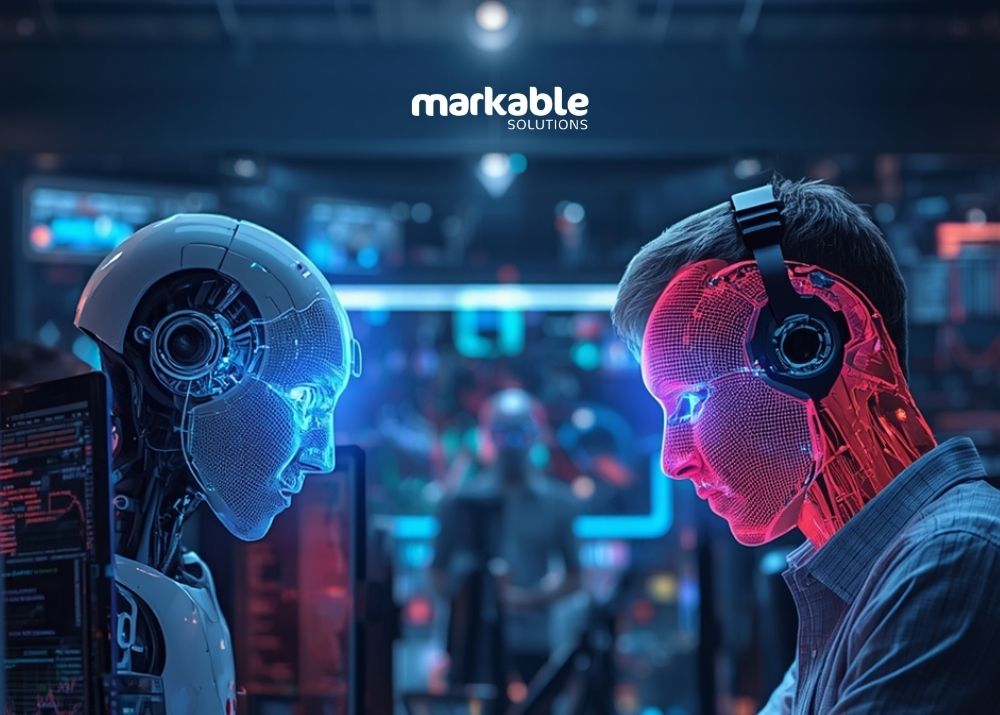
Highlights
- Understand AI SDRs and human SDRs and their role in modern B2B sales.
- Learn about the capabilities of AI and human expertise in B2B sales prospecting.
- Discover why a hybrid model of AI SDRs and human SDRs builds a predictable pipeline.
- Explore how AI and human SDRs complement each other across prospecting, qualification, and deal progression in B2B sales.
- Find out how Markable Solutions combines AI-powered automation with experienced SDRs to accelerate B2B revenue growth.
Introduction
Artificial Intelligence (AI) has changed how companies operate, and sales development is no exception. From prospect research and personalized outreach to lead qualification and follow-ups, AI is reshaping how organizations build and manage their sales pipeline. As businesses increasingly adopt AI-powered sales technologies, one question continues to dominate B2B leaders’ minds: whether AI SDRs or human SDRs are best for B2B sales? The debate centers on how efficient sales technology is and whether human expertise is still relevant in building a qualified B2B pipeline. As a leading B2B sales lead generation agency, we have insights that will let you decide which should be your go-to strategy for building a stronger sales pipeline.
Today, AI SDRs can send personalized emails, qualify prospects, book meetings, and offer round-the-clock availability. On the other hand, human sales development executives continue to demonstrate their expertise in building and strengthening customer relationships. Businesses rely on them to handle complex problems, make prospective buyers aware of solutions that can help them overcome their challenges, and deliver high customer satisfaction. Most successful B2B SaaS companies combine both AI SDRs and human SDRs to achieve a high conversion rate. For a product-led growth (PLG) model, AI SDRs can engage with free trial users and support onboarding. In a sales-led SaaS model, they build qualified opportunities based on the BANT lead qualification model and guide prospects through the B2B SaaS buying process.
The question is no longer whether companies handle their sales with AI SDRs alone, or whether they need human sales representatives to manage their operations. The bigger question is: can both coexist and help companies build a sustainable B2B pipeline? Let’s discuss and analyze what your go-to strategy should be. Learn from Markable Solutions, a reputed B2B sales lead generation agency.
What is an AI-SDR?
An AI-SDR refers to an ‘Artificial Intelligence Sales Development Representative’, an AI software system that automates the repetitive tasks involved in sales prospecting and lead qualification. AI SDRs can perform tasks such as prospect research, personalizing outbound emails, instantly following up to answer routine questions, and scheduling meetings. This sales intelligence technology can also score leads based on buying signals. The technology supports human SDRs by helping them focus on meaningful conversations and convert interest into conversions. According to Salesforce’s 2026 State of Sales, sales representatives spend only 40% of their time on active selling. The rest of their time is spent on managing administrative work, research, and other internal tasks. AI SDRs can easily take responsibility for these admin tasks, while sales representatives can focus on active selling.
When Do AI SDRs Matter?
Reach at scale: Once you have defined the ideal customer profiles (ICPs), the target industry, and tailored communication to recipients’ needs, the challenge is reaching prospects at scale. AI SDRs can target top-of-funnel leads by focusing on the selected accounts and decision-makers, initiating conversations while keeping personalization intact. They can automate prospect research, reach a much larger audience, and follow up promptly. The AI initiates conversations and keeps buyers engaged, and at the right time, human SDRs intervene to move deals forward. The HubSpot 2025 data says that 64% of sales representatives save 1-5 hours per week via AI automation. Sellers who use AI for prospect research save an average of 1.5 hours per week.
Round-the-clock availability: AI SDRs are highly useful for offering 24/7 availability to your customers. For business organizations that operate across multiple time zones, AI SDRs are a real savior, because a business need not deploy human agents beyond regular business hours. Instead, the AI SDRs take over and fill the gap for the business. The software instantly responds to buying signals and updates the CRM system with the new leads, irrespective of whether they engage beyond business hours or on weekends. The prospects and sellers feel connected, heard, and seen with instant responses. Human SDRs can take the discussion forward and close deals faster.
Personalized Communication: B2B prospects want companies to have context for their needs and expect communication tailored to their requirements. AI sales technology can research a large number of accounts across various platforms and can identify their intent and requirements. This helps sales teams easily identify opportunities that might go unnoticed. When sending emails, the software takes into account all live signals, making communication more personalized and relatable to the recipient’s needs.
Why are human SDRs important in B2B sales?
Gartner has predicted that organizations using Gen AI in sales will reduce prospecting and meeting preparation time by more than 50%. But enterprise business decisions are still influenced by a human, trusted, and collaborative approach, so human SDRs are required for deal progression. As a leading B2B sales lead generation agency, we leverage technology to empower our human SDRs to improve sales efficiency.
Relationship Building: The foundation of B2B SaaS sales, or any sales, is trust, and that trust is built by human SDRs. In the age of AI taking over almost all business processes, the differentiating factor remains the human element. In B2B sales prospecting, AI SDRs can identify prospective buyers, initiate conversations, personalize outreach, and automate follow-ups at scale; human SDRs are still required because they have traits such as empathy, contextual understanding, real-time sentiment analysis, and also understand unspoken challenges that come from expertise and dealing with humans on a day-to-day basis.
Qualify buying Intent: Though AI can identify prospective buyers and engage with them through initial conversations, human SDRs can determine genuine buying interest. Intent data will lead you to prospective buyers, but one-to-one conversations offer the opportunity to adjust the conversation based on the buyer’s reactions. Critical thinking, presence of mind, and proactive engagement matter in deal progression and ultimately closing the deals. Human sales reps engage prospects with meaningful conversations, understand budget approvals, decision-making authority, business need, and implementation timelines by uncovering real intent. They can identify hidden objections that automation might miss. So human SDRs are critical to sales prospecting and winning B2B deals.
Navigate complex enterprise sales: The B2B sales cycle is long and complex, as it involves multiple stakeholders. Here, human SDRs have a crucial role, as they can communicate with each member of the buying committee. Though the initial conversations can be handled by AI SDRs, later in the sales cycle, B2B buyers trust the human factor. B2B deals require human intervention, as human reps can understand the complexities and dynamics of organizational hierarchy. They can address each stakeholder’s needs, moving the conversation toward conversion. B2B procurement decisions weigh financial and operational risk and require customized demonstrations that address challenges in real time. The conviction to make the B2B SaaS buying decision comes from human sales representatives who understand the concerns of the buying committee and guide them through the buying cycle.
AI SDRs and Human SDRs: The Hybrid Model: Get the best of both worlds
From the above discussion, we can conclude that for businesses, the debate should no longer be about AI vs. human SDRs; it’s about tapping the best of both elements in B2B sales prospecting. The most successful B2B SaaS companies do not choose one option, but adopt a hybrid approach. AI supports sales enablement and human expertise to close B2B deals. AI can identify prospects, research their needs, be available 24×7, follow up instantly, and schedule meetings. The next part of the sales process is handled by human SDRs, who leverage their strengths, such as contextual understanding, real-time objection handling, understanding the complex business challenges prospects face, and guiding prospects toward the buying stage. For B2B SaaS companies, a hybrid AI and human SDR model delivers the best results across both product-led growth (PLG) and sales-led growth motions.
How Markable Solutions Combines AI with Human Expertise
Markable Solutions, a leading B2B sales lead generation company, believes in leveraging the human expertise of our trained sales development representatives, who navigate the complex B2B sales process with their experience and the ability to interpret context and adapt conversations in real time based on prospects’ responses. While AI can accelerate prospecting and outreach, complex, long-term B2B buying decisions are influenced by human representatives. We leverage technology to support our human agents in prospect research, identifying ICPs and personalizing the outreach. As an experienced B2B sales lead generation company, we blend human expertise and technology to deliver the best of both in B2B sales prospecting. Book a free session with our experts to understand how we can apply the hybrid sales prospecting approach to your business and help you accelerate the B2B sales cycle.
FAQs
What is an AI SDR?
An AI SDR refers to an Artificial Intelligence Sales Development Representative. It is software used in sales prospecting to automate various parts of the process, such as ideal customer identification, prospect reach, personalized outreach, follow-up, and meeting scheduling. It reduces manual efforts and helps human SDRs close deals more efficiently.
What is the role of a human SDR?
A human sales representative is responsible for building customer relationships, proactively engaging with leads, handling objections, thinking critically, understanding prospects’ challenges, adapting to the conversation in real time, and moving opportunities forward.
Can AI replace human SDRs?
No, AI won’t completely replace human SDRs. In fact, AI-enabled technology can support them and help build a sustainable B2B pipeline. AI automates repetitive tasks, but human SDRs are important for building customer relationships and navigating the complex qualification process to generate a sales-qualified pipeline.
How does AI help in sales?
AI tools are highly effective at identifying prospective buyers, personalizing outreach, and automating follow-ups at scale. Human SDRs take the conversation forward through one-to-one interactions with prospective buyers. They can efficiently qualify prospects and build the trust needed to convert interest into sales opportunities. A B2B sales lead generation agency prefers a hybrid approach towards B2B sales prospecting.
Should companies hire AI SDRs or human SDRs?
It’s not about AI SDRs vs human SDRs because a hybrid model works best for businesses. AI can handle prospect identification, initial research, and outreach follow-ups. But as the conversation progresses, human expertise is needed for their articulateness, capability to handle objections, relationship building, and qualifying high-intent prospects. These are sales-qualified opportunities that the sales or business development team can nurture and convert into customers.