Introduction
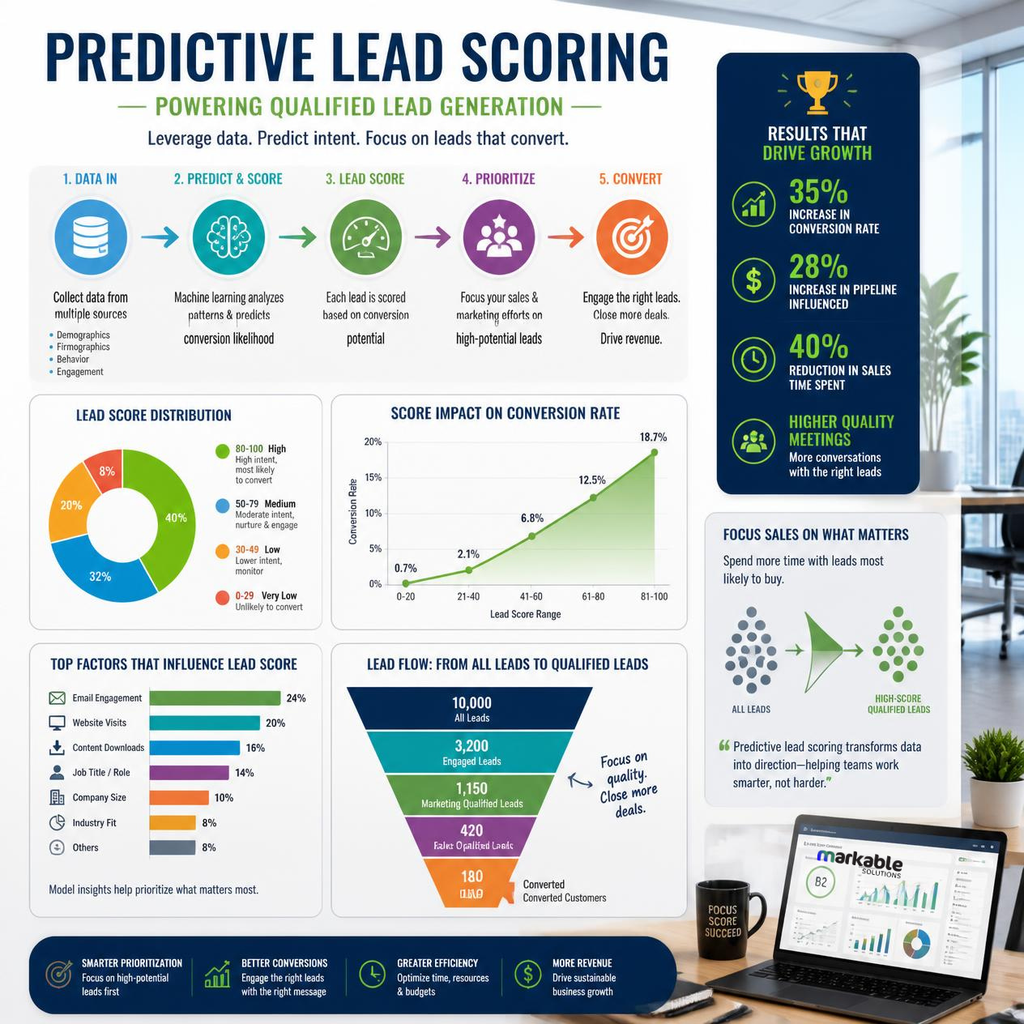
Predictive lead scoring assigns scores to leads using historical CRM data and machine learning (ML). This AI-enabled technology helps prioritize leads based on patterns that demonstrate which leads converted and which did not. It also explores which leads are the best fit, which becomes a blueprint for lead prioritization. It differs from traditional lead scoring, where static rules apply. An AI-led lead-scoring method adopted by a B2B sales lead generation agency relies on AI-enabled technology, such as Machine Learning models, to analyze large datasets and predict the probability of lead conversion. It helps RevOps teams adopt effective strategies to build a strong revenue pipeline. The technology uncovers user behavior and patterns, leveraging firmographic, demographic, and technographic data. It leverages intent-data marketing to identify in-market B2B buyers and their requirements, thereby supporting qualified lead generation.
Key Highlights
- Predictive lead scoring is an advanced approach to scoring leads and assigning them values using AI-enabled technology and Machine Learning (ML) based on historical data. It is a data-driven approach that evaluates the probability of lead conversion into customers.
- AI-enabled lead scoring helps business leaders and revenue operations (RevOps) teams adopt tailored strategies to build a sustainable revenue pipeline.
- Predictive models leverage intent data marketing to go beyond static firmographic data and evaluate demographic and technographic data, layered with buyer behavior. They can build a B2B prospect list with a higher likelihood of conversion.
- AI-enabled lead scoring offers the sales and marketing teams a competitive edge. They can choose the right time to engage leads based on their behavior, ensuring smoother deal progression.
- Machine-learning-led lead scoring helps the sales team focus on high-intent leads with a high probability of conversion. It helps them shorten the B2B sales cycle by directing their efforts into nurturing high-intent leads.
- AI-enabled lead scoring increases the lead conversion rate with sales and marketing alignment. Both teams work with shared processes and technology, and a unified understanding of an ideal customer profile (ICP), implying an intent to make a buying decision.
- For a predictive scoring model to work, the data needs to be of high quality. Data should be appended regularly, and data enrichment should be the norm to achieve the best results.
- Human judgment still matters in predictive lead scoring and does not replace the SDR capabilities. A B2B sales lead generation agency does not diminish the role of human reps, as AI-led lead scoring still requires human capability to add contextual understanding and to adopt a personalized engagement approach unique to each lead to drive high conversions.
Detailed Section
Why is predictive lead scoring more accurate than traditional lead scoring?
Traditional lead scoring relies on a static point system and guesswork. In contrast, AI-enabled lead scoring uses machine learning to help businesses prioritize high-intent leads and build a sustainable B2B pipeline. Sales teams can focus on leads backed by data that supports their probability of conversion. It’s no longer guesswork but a precision-led, data-driven approach that ensures leads assigned high value have a high probability of conversion. No wonder a reliable and experienced B2B sales lead-generation agency in California, Chicago, or New York prefers this tech-enabled approach in lead scoring.
AI-enabled lead scoring supports qualified lead generation. Marketing and sales refer to a common definition of ICPs and identify high-intent leads by considering analytics-driven insights. The data uncovers patterns across previously generated marketing-qualified and sales-qualified leads, as well as opportunity-to-win rates. These insights determine conversion probabilities and are fed into the CRM to improve the AI-enabled lead-scoring model.
How does Predictive lead scoring work?
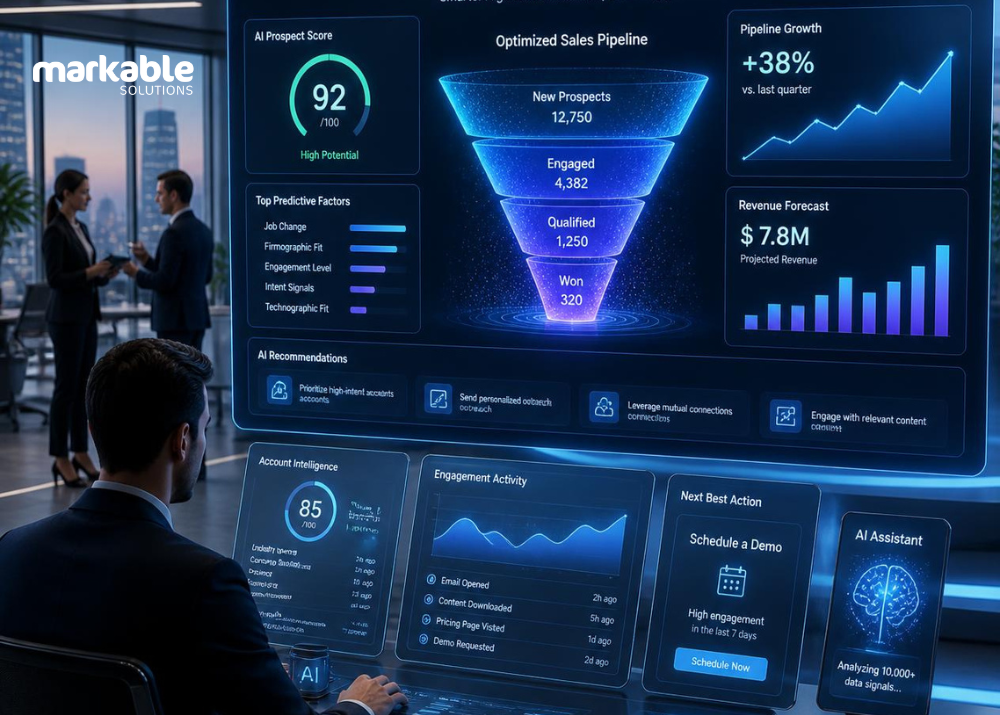
Machine learning-enabled lead scoring leverages AI and machine learning to rank leads and assign them scores indicating how likely they are to convert into customers. The higher the score assigned with AI-enabled technology, the higher the probability of conversion. The technology analyzes firmographic, demographic, and buyer behavior and intent signals to identify patterns in leads that have converted previously. It assigns scores based on these data, ranging from 0 to 100. The scores are dynamic and change based on buyer behavior. AI-enabled technology considers real-time buying signals and keeps the lead conversion prediction rate as accurate as possible. However, the judgment of human SDRs remains non-negotiable, as they can validate the score through one-to-one real-time conversations that the technology cannot fully capture.
Best Practices for Predictive Lead Scoring
A B2B sales lead generation agency in the United States will ensure AI-enabled technology yields the desired result by leveraging machine learning-led lead scoring modeling in the best possible manner. Ask any demand generation company in California, Chicago, or New York with extensive industry experience; it will ensure the lead-scoring model is trained and retrained to align with buyer behavior and their historical data.
- Data quality is an important factor to consider, as machine learning-enabled lead scoring relies on the data it has been trained on. Businesses must clean the database to remove obsolete data and add relevant information through data enrichment services.
- It is vital to rely on intent data marketing and to enhance firmographic, demographic, and technographic data, paired with real-time buying signals, to identify high-intent leads and accurately assign scores to them.
- Predictive lead scores make AI B2B sales prospecting a success. The scores should be integrated into existing CRMs to provide sales and marketing teams with full visibility into the prospect journey. This helps them adopt tailored engagement strategies to move leads through the B2B marketing funnel more quickly.
- Businesses must evaluate the scores assigned by machine-learning-led lead scoring to refine the criteria used to assign those scores to leads. They must evaluate pipeline velocity, deal progression, and opportunity-to-win rate to determine whether the assigned lead scores are accurate. It offers them the opportunity to refine the training model to improve accuracy and offer correct insights for high-quality lead generation.
A predictive lead-scoring model is a win-win for marketing, sales, and RevOps teams
Predictive lead scoring helps build a sustainable revenue pipeline by providing visibility into which leads are likely to convert and insights into why certain values were assigned. The RevOps teams can make better revenue decisions by gaining a contextual understanding of the assigned scores. The team can understand the marketing strategy, determine the lead handoff from marketing to sales, and evaluate the lead-scoring model by analyzing its impact on the revenue pipeline. It enables sales reps to tailor sales conversations based on scoring results from machine-learning-powered data analytics. Data-driven insights enable better resource allocation, as marketing teams can evaluate how their content marketing and waterfall content syndication are performing and how ICPs respond to the content. The sales, marketing, and RevOps teams can shift their focus from lead volume to qualified lead generation.
FAQs
What is meant by predictive lead scoring in B2B lead generation?
Predictive lead scoring leverages AI-enabled technology and machine learning (ML). It identifies historical patterns by taking into account buyer behavior and is backed by intent-data marketing. A B2B sales lead generation agency evaluates buyer readiness by analyzing firmographic, demographic, and technographic datasets with intent-aligned buyer signals.
What is the difference between manual lead scoring and predictive lead scoring?
The difference between the two lead-scoring methods lies in how leads are evaluated and scored. In the manual process, leads are evaluated and assigned scores using fixed, predefined criteria such as company size, job titles, and similar factors. On the contrary, predictive lead scoring uses AI-enhanced machine learning (ML) to boost qualified lead generation by integrating intent data across demographic and technographic dimensions. It offers higher conversion prediction accuracy than manual lead scoring.
Will predictive lead scoring eliminate or reduce the dependency on human SDRs?
Technology will not replace human SDRs and SDR-led telemarketing services, as their judgment is crucial in evaluating the scores assigned by technology. They apply contextual judgment to evaluate scores, consider factors such as prospect requirements, and determine the best customized approach for engagement.
How does predictive lead scoring support qualified lead generation?
Predictive lead scoring helps identify leads that are more likely to convert by analyzing firmographic, demographic, technographic, behavioral, and intent data. It unifies marketing and sales teams to prioritize high-potential leads, enabling RevOps teams to make better revenue decisions. Such alignment and a shared approach create revenue opportunities and enable teams to capture them at the most opportune moment. All teams can prioritize qualified lead generation by leveraging AI-enabled technology to score leads and assess their eligibility for conversion.
Is the predictive lead scoring derived lead score static?
Most of these scores are constantly changing, as they take into account real-time buying signals. High-quality lead generation is possible with accurate dynamic lead scores and insights derived from human SDR-led, one-on-one conversations. A B2B sales lead generation agency in California, Chicago, or New York continually refines its strategy by retraining its machine learning models and driving high-quality leads into the sales funnel.
Conclusion
Predictive lead scoring analyzes large datasets and historical data to identify patterns in lead activity and buyer behavior by leveraging AI-enabled insights and machine learning (ML). It helps the sales team understand the key characteristics of leads that move faster through the funnel and convert into customers. Real-time scoring helps the sales and marketing team understand lead intent and deliver personalized engagement to convert them into customers. Predictive lead scoring helps RevOps connect lead data with revenue outcomes, creating a feedback loop that involves the sales and marketing teams. It continuously improves the scoring model and builds a predictable revenue pipeline.
Rather than relying on manual lead scoring, a B2B Sales lead generation agency leverages AI-enabled technologies, such as machine learning (ML), to implement precision-led B2B lead generation and account-based marketing (ABM) campaigns. The AI-led lead-scoring model is dynamic and adapts to intent data, buyer behavior, and account profiles.