How to use AI without Hurting Personalization
Introduction
Leveraging Artificial Intelligence (AI) has become mainstream in every B2B lead generation function. From identifying the ideal customer profiles (ICPs) to customizing messaging and follow-up, AI has made its presence felt loud and clear. AI automation, marketing, and sales intelligence tools offer speed, agility, and higher efficiency. They streamline lead-generation campaigns, enabling a B2B sales lead-generation agency to drive high-quality leads into the marketing funnel. But a question arises: are businesses over-automating lead generation and account-based marketing programs? Are they wanting too much from AI-enabled technology? Has it, instead of delivering the desired results of improved engagement, flipped the process and weakened engagement? Agencies offering AI lead generation services also prioritize human expertise to drive qualified leads into the marketing funnel.
The Automation Trap
The AI wave is sweeping through businesses, prompting them to add a range of AI tools to their tech stacks. They are putting lead generation on autopilot, expecting qualified leads to follow. But automation alone does not yield a qualified lead-generation pipeline. On the contrary, it can simply flood your pipeline with contacts who may not engage with you at all! Real qualification still depends on human judgment. Outsourcing lead generation can help you drive high-quality leads into your sales funnel. A B2B sales lead generation agency brings the human expertise needed to read a signal correctly, identify which details are worth mentioning, understand the prospect’s context, and recognize which leads to prioritize. The agency will combine human expertise to turn AI-generated data and signals into revenue opportunities. The goal is to automate lead volume with AI, not judgment and contextual understanding, which human-led one-to-one conversations alone can provide.
Qualified Lead Generation with AI: How Much to Automate
No doubt AI has infinite capabilities; it’s critical in automating manual processes that would otherwise take weeks or months. According to HubSpot, 84% of sales professionals say AI helps them save time, while 83% say it improves personalization. Also, 82% of these professionals say that AI offers better insights from data. Such industry research demonstrates the importance of artificial intelligence in AI lead generation services. AI-driven technology is required to accelerate sales velocity and maximize revenue for businesses by identifying and tapping revenue opportunities faster. But businesses need to understand when and how to automate the process and where to keep the human expertise intact. In this blog, we’ll help you decide on the role and the correct workflow for AI integration in B2B lead generation, where to automate and where to leverage human expertise.
Why AI-enabled technology matters in Qualified Lead Generation
AI integration offers several advantages in lead generation and account-based marketing (ABM) campaigns. It has made marketing more effective and sales conversations more impactful, driving qualified lead generation.
- ICP Identification: Before starting any campaign, businesses must identify the audience that aligns with their ideal customer profile and buyer persona. This is where AI has a strong use case. AI can research and analyze large datasets much more efficiently and quickly than manual research. AI marketing automation tools, driven by intent data, can help you identify your ICPs. Intent data offers insights into real-time buying behavior. As a business that wants to stay ahead of the competition, it must leverage intent data marketing to find the in-market audience. Once the target audience has been established, the marketing and sales teams leverage AI-enabled technology to personalize the communication.
- Personalization: As a leading B2B sales lead generation agency in the United States, we have always emphasized the importance of audience-specific messaging in lead generation and account-based marketing (ABM) campaigns. Industry research shows that customized outreach is a key component in increasing response rates and encouraging prospective B2B buyers and customers to respond to communication. The key is to evoke a positive response from the recipient; only then can the marketing and sales teams take the conversation forward. According to the Salesforce State of the AI Connected Customer report, buyers expect businesses to be aware of their history and context for their current problems while communicating with them. AI can create the first version, but a human needs to review it before it is sent. The final message requires human judgment to ensure the tone, context, relevance, and intent are right and unique to the prospect. AI can help businesses achieve this customized outreach at scale by analyzing prospects across datasets and analyzing their behavioral and engagement data to identify buying signals. It can help determine the right messaging and even the best timing to communicate with each prospect.
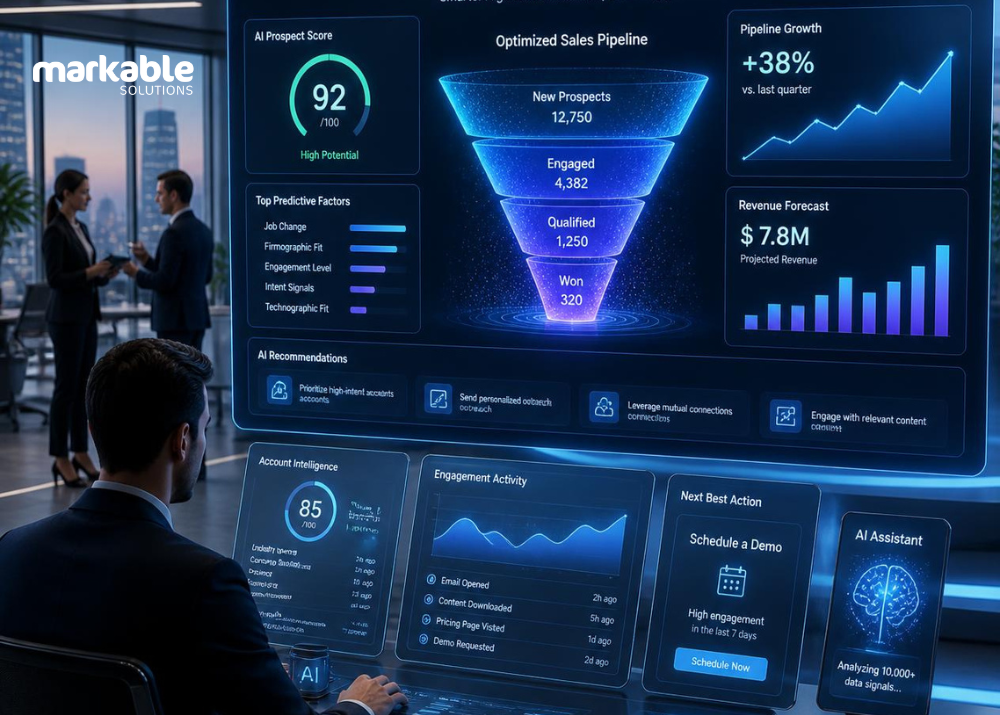
- Faster deal progression: AI tools work on firmographic, demographic, and technographic data layered with buying-intent signals. They use intent-based data, enabling the sales and marketing team to align communication with the prospects’ requirements rather than relying on guesswork. In fact, McKinsey research also stated that organizations integrating AI into core workflows report seller efficiency (59%) and better customer experience (53%) as major benefits. With AI-driven prospect-specific messaging and the ability to craft messages at scale, teams can engage prospective buyers more efficiently. The sales and marketing teams get continuous visibility across the marketing funnel. Actionable insights into the buyer journey enable them to tailor engagement, drive responses, and ensure a smooth handoff from marketing to sales. It leads to faster sales velocity and enables businesses to win more B2B deals. AI in B2B lead generation makes the process more agile, adaptable, personalized, and aligned to the B2B buyers’ requirements. These benefits of artificial intelligence in workflows ensure faster deal progression.
When and where human expertise shines in qualified lead generation
AI technology offers greater efficiency, broader reach at scale, personalization, speed, and agility, making the B2B lead generation process more efficient and successful. But here’s the catch: it’s not AI integration all the way; you need to know where to let AI-enabled tools work at full capacity in your marketing process and where to leverage your human team’s talents. AI has many use cases in B2B lead generation, as discussed above, but it requires human judgment to use it effectively. Please remember that it’s great to adopt the latest AI-enabled technology to integrate customization, but the communication should not feel automated. Let’s discuss where human expertise is required to win more B2B deals.
- Deciding what to personalize: Yes, relevance beats personalization. Not everything needs to be personalized. As a leading B2B sales lead generation agency, we champion relevant messaging as the key to making communication resonate with the target audience. But businesses need to understand that tailored communication should be incorporated only to make conversations more meaningful and purpose-driven. Having access to AI-driven technologies does not mean adding personalized details to every message. It must be added only when it is relevant and serves the purpose of outbound outreach. Tailored messaging should give prospective buyers a reason to continue the conversation rather than disappointing them by merely repeating information already publicly available. For instance, if a prospect has recently been promoted, simply congratulating them on their new role will not take the sales conversation forward. It is advisable to leverage AI further to analyze the company’s recent developments. Consider the company’s recent expansion plans, including mergers and acquisitions, as well as changes associated with the prospect’s elevated role. The outreach can then connect the promotion to a potential business solution and open the door to a relevant discussion.
- Review communication: As a leading B2B sales lead generation agency in United States, we have extensively worked with AI tools. We continue to leverage them as a sales enabler by pairing them with human expertise. It’s great to start the B2B lead-generation process by identifying ICPs, crafting personalized messages, and automating follow-ups. But we also firmly believe that in AI lead generation services, AI tools can initiate the lead generation process, then let human experts take over message customization to make outbound outreach more successful. Human expertise is and will remain relevant because we need not automate everything. Though AI can automate the end-to-end process, it requires human intervention at the right juncture of the buyer journey, which can make or break the deal. For instance, businesses can generate the first message with AI, and then the marketing and sales teams can edit it to make it more impactful and to ensure it resonates with the target audience. Human feedback and review are particularly important, as they can help the AI-enabled workflow achieve lead-generation goals faster and increase the opportunity win rate.
- One-on-one conversations: Sales-led motions rely on human judgment that AI can’t replicate. In enterprise B2B SaaS deals, where deal sizes are large and buying committees are complex, it’s the SDR-led telemarketing that makes the difference. One-to-one conversations enable sales teams to qualify leads using the BANT lead qualification method. Human-led direct conversations provide opportunities for objection handling, doubt clearing, and making the conversation more meaningful. Product-led growth (PLG), on the other hand, can drive B2B leads without necessarily requiring human intervention. In fact, a hybrid growth model is best for increasing revenue opportunities and achieving customer expansion goals. The conversation with prospective buyers makes all the difference between reaching the decision-making stage and closing the deal. AI can identify ICPs and craft relevant messaging to help the sales team close deals. But human expertise, such as active listening, empathy, contextual understanding, on-the-spot objection handling, and offering alternative solutions if the primary pitch did not resonate, is what closes the deal. So, AI and human expertise are a winning combination for AI lead generation services.
How AI and Human Expertise work together in AI lead generation services
| Lead Generation Stage | Priority | Reason |
| ICP and account identification | AI | High speed; data volume beats manual research |
| Signal monitoring, tracking changes in ICP (funding, hiring, expansion) | AI | Constant, scalable, and real-time tracking |
| First communication | AI | Artificial Intelligence removes the friction of starting from scratch |
| Deciding which signal matters | Human process | It needs more than pattern-mapping; human judgment is required |
| Final review before hitting the send button | Human process | Humans assess tone, context, and relevance and can avoid potential misinterpretation |
| Live conversation and objection handling | Human process | SDR-led telemarketing can interpret intent and handle objections in real time |
FAQs
- Does AI in B2B lead generation hurt personalization and response rates?
No, AI does not hurt personalization or reduce the response rate; in fact, it is required to fast-track the lead-generation process. It can result in qualified lead generation when it is paired with human judgment. Human expertise is necessary to make the communication truly personalized, as AI-generated responses may eventually look the same and generic. It’s great to start with AI drafting personalized messages, but further refinement with human expertise and a keen eye for detail is what makes the message personalized and aligned with the buyer’s expectations.
- Is human expertise needed in the age of AI in outbound reach?
Integration of AI makes the lead generation process faster and more data-driven, but it does not eliminate the need for human expertise. A lead generation company in United States, such as San Francisco, Chicago, or New York, will leverage a hybrid model to reach out to potential customers. Humans can interpret context and determine whether an insight is genuinely relevant and how the conversation can be taken forward.
- How can you tell if the communication is overly automated?
Suppose the email or outbound messages read as if they could have been replaced with any other company name (yes, businesses need to go beyond the recipient’s name and job title). If it can be swapped, it’s not customized outreach; it’s just sprinkled with so-called superficial tailored communication. The message should demonstrate an understanding of the company’s historical data, background, and behavioral signals, as well as each buying committee member’s priorities, to make it truly personalized.
- How do artificial intelligence tools deliver personalization and assist in qualified lead generation?
AI can integrate customization into engagement by analyzing account information across demographic, firmographic, and technographic data and offering insights into the prospect’s background. It relies on behavioral signals and intent-based marketing data, but it is effective only when backed by human judgment. Humans will validate the information, determine whether customization is required, and refine the messages to ensure they truly resonate with the recipient.
Conclusion
Businesses are using artificial intelligence in every operation, and outbound reach is no exception. Artificial intelligence-enabled technology helps achieve agility, speed, and efficiency in AI lead generation, but the problem arises if the recipient feels the message is overly engineered and automated. Yes, contextual messaging is important for making communication more personal and responsive, but it should not hurt personalization. The outbound reach should not make the conversation feel overly automated, and prospects should not sense that the human touch is missing. Technology is great, but if the human connection is missing, an otherwise positive lead will not convert. At the end of the day, it’s the human connection that will make the lead generation and ABM campaigns successful. If you are leveraging AI tools but still missing the mark, and your outreach is generating volume but not meaningful conversations, the gap is evident. It’s too much automation, not enough judgment.
Markable Solutions helps B2B teams build qualified lead-generation programs that leverage our latest AI stack, embedded with cutting-edge tools managed by our experts to make outbound outreach personalized and successful. Our lead generation experts use AI as a sales enabler while prioritizing human expertise.
Book a discovery call with our team to effectively leverage AI lead generation services. Avoid falling into the automation trap with the help of experts.